
Level 1 · Beginner 1 · Unit 5
Three apples, please
By the end you can
- Count with both number systems
- Ask the price
- Buy things in a shop
Part 1
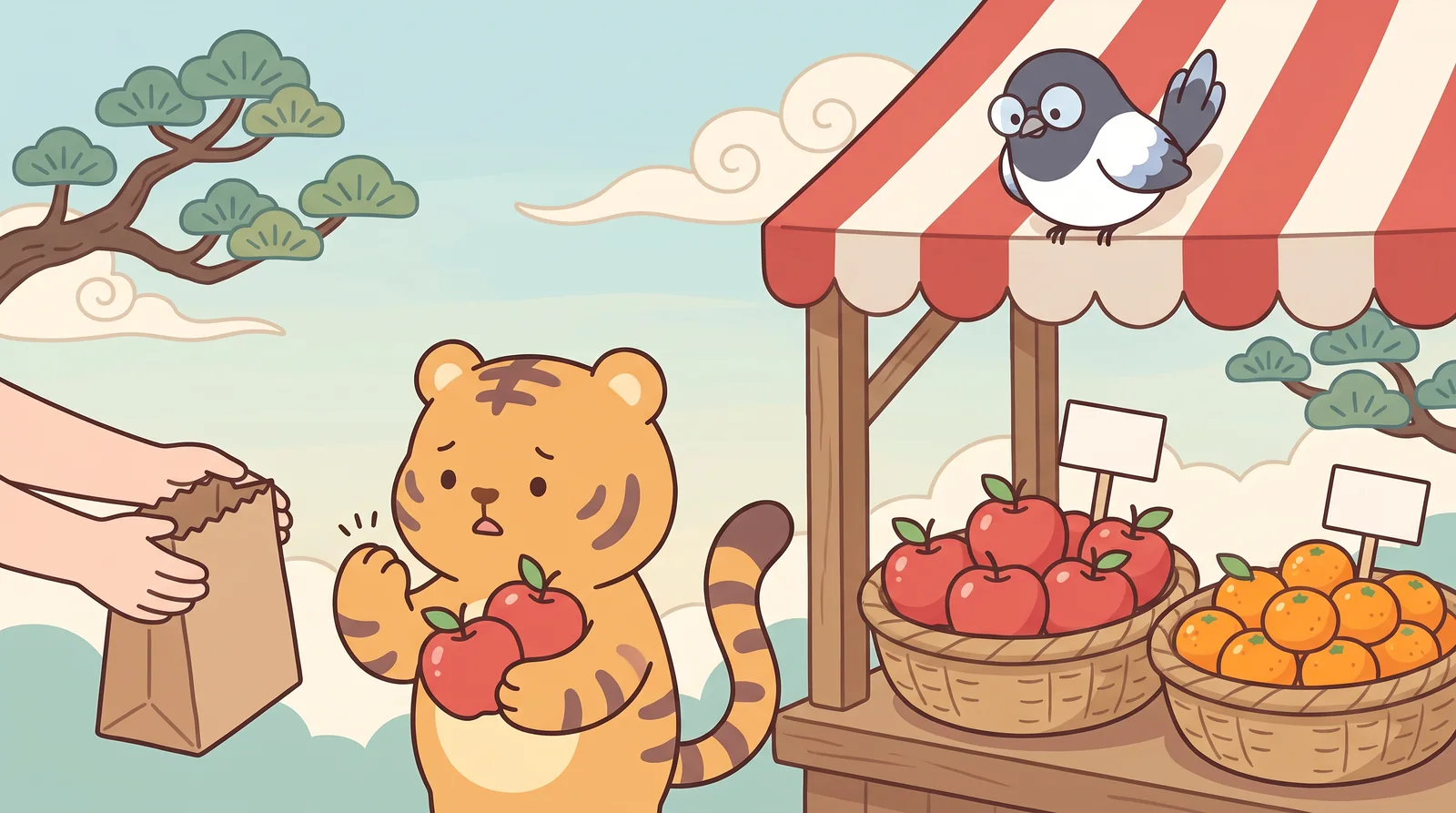
Hoya at the fruit stall
Listen first. Then hide the English and read along. Then use Shadow: Sori or Hoya says a line, you say it back.
- S
Shopkeeper
어서 오세요!
Welcome!
-

사과 얼마예요?
How much are the apples?
- S
Shopkeeper
한 개에 천 원이에요.
They're 1,000 won each.
-
사과 세 개 주세요.
Three apples, please.
- S
Shopkeeper
네. 귤은요? 귤이 아주 맛있어요.
Sure. What about tangerines? They're very good.
-
귤은 얼마예요?
How much are the tangerines?
- S
Shopkeeper
다섯 개에 삼천 원이에요.
Five for 3,000 won.
-
그럼 사과 세 개하고 귤 다섯 개 주세요.
Then three apples and five tangerines, please.
- S
Shopkeeper
모두 육천 원이에요.
That's 6,000 won altogether.
-
여기 있어요.
Here you are.
- S
Shopkeeper
감사합니다. 안녕히 가세요!
Thank you. Goodbye!
-

호야 씨, 사과 세 개… 다 호야 씨 거예요?
Hoya, three apples… are they all yours?
-
아니요! 하나는 소리쌤 거예요.
No! One is yours, Sori-ssaem.
Part 2
Grammar
5 patterns, each with the rule and examples you can hear.
일 · 이 · 삼 … + 원
Sino-Korean numbers and money
Korean has two sets of numbers. The Sino-Korean set (from Chinese) is used for money, minutes, dates, phone numbers and floors. Two habits to learn: say 천 and 만 on their own, never 일천 or 일만; and count big numbers in units of 만 (10,000), not thousands.
| 1–10 | 일 이 삼 사 오 육 칠 팔 구 십 | 십오 = 15 · 이십 = 20 |
|---|---|---|
| 100 · 1,000 · 10,000 | 백 · 천 · 만 | 천 원 · 만 원 (no 일 in front) |
| large numbers count in 만 | 만 | 20,000 = 이만 · 35,000 = 삼만 오천 |
천 원이에요.
It's 1,000 won.
삼천오백 원이에요.
It's 3,500 won.
만 오천 원이에요.
It's 15,000 won.
하나 · 둘 · 셋 … + 개 · 명 · 병 · 잔 · 권 · 마리
Native numbers and counters
To count things, use the native Korean numbers with a counter — a small word for the kind of thing. The order is noun, number, counter: 사과 세 개. Before a counter, 하나 · 둘 · 셋 · 넷 shorten to 한 · 두 · 세 · 네.
| 1–5 | 하나 둘 셋 넷 다섯 | 한 개 · 두 명 · 세 병 · 네 잔 · 다섯 권 |
|---|---|---|
| 6–10 | 여섯 일곱 여덟 아홉 열 | 여섯 마리 · 열 개 |
| before a counter | 한 · 두 · 세 · 네 | 하나 → 한 개 · 둘 → 두 개 |
| the counters | 개 · 명 · 병 · 잔 · 권 · 마리 | things · people · bottles · cups · books · animals |
사과 세 개
three apples
커피 두 잔 주세요.
Two coffees, please.
고양이가 두 마리 있어요.
There are two cats.
N 주세요
Asking for something
주세요 means “please give me”. Put the thing — and how many — in front of it. It's all you need in a shop, a café or a restaurant.
물 주세요.
Water, please.
커피 한 잔 주세요.
One coffee, please.
이거 주세요.
This one, please.
얼마예요?
How much?
얼마 means “how much”. For a price per item, add 에 to the amount: 한 개에 천 원 — “1,000 won for one”.
이거 얼마예요?
How much is this?
한 개에 천 원이에요.
It's 1,000 won each.
모두 얼마예요?
How much is it altogether?
N하고 N
And (between nouns)
하고 joins two nouns: 사과하고 귤, “apples and tangerines”. It's the spoken choice; in writing you will also see 와/과.
사과하고 귤 주세요.
Apples and tangerines, please.
빵하고 우유를 사요.
I buy bread and milk.
커피 한 잔하고 물 한 병 주세요.
One coffee and a bottle of water, please.
Part 3
Words
41 words. Tap a card to hear it. When you finish, they go into your review — they come back tomorrow.
Sino-Korean numbers
native numbers
counters
at the shop
Part 4
Practice
Check each answer as you go. Nothing is graded — mistakes are how this works.
Which set of numbers?
-
(3) 사과 ___ 개 주세요.
Three apples, please.
-
(3,000) ___ 원이에요.
It's 3,000 won.
-
(2) 커피 ___ 잔 주세요.
Two coffees, please.
-
(1) 학생이 ___ 명 있어요.
There is one student.
Which counter?
-
우유 두 ___ 주세요.
Two bottles of milk, please.
-
책 한 ___ 있어요.
There's one book.
-
고양이가 세 ___ 있어요.
There are three cats.
Put the words in order
-
Three apples, please.
-
How much is this?
-
Apples and tangerines, please.
Choose the right answer
-
이거 얼마예요?
How much is this?
-
모두 얼마예요?
How much is it altogether?
Part 5
Fix Hoya’s mistakes
Hoya wrote these. Each has one mistake — the kind a sensible learner makes. Say the fixed sentence before you check.
-

Ask for three apples.
Hoya wrote 사과 삼 개 주세요.
Show the fix
사과 세 개 주세요.
Counters like 개 use the native numbers: 셋 → 세 개. 삼 is for money, minutes and dates.
-
Ask for one apple.
Hoya wrote 사과 하나 개 주세요.
Show the fix
사과 한 개 주세요.
Before a counter, 하나 shortens to 한 (둘 → 두, 셋 → 세, 넷 → 네).
-
Read the price ₩20,000 out loud.
Hoya wrote 이십 원이에요.
Show the fix
이만 원이에요.
Korean counts big numbers in 만 (10,000). 20,000 is two 만: 이만. 이십 원 is only 20 won.
Part 6
Hoya's receipt
Back home, Hoya reads his receipts out loud and checks his wallet. Read it yourself first; tap a line to see its meaning, or listen to Hoya read it.
Three apples, 3,000 won.
Five tangerines, 3,000 won.
One bottle of milk, 1,800 won.
Two hotteok, 2,000 won.
That's 9,800 won altogether.
There's 200 won in my wallet.
Check your reading
-
How many tangerines did Hoya buy?
-
How much did he spend altogether?
Part 7
Writing
You're in a shop. Write what you say to buy three things.
See Sori’s model answer
- 안녕하세요. Hello.
- 이거 얼마예요? How much is this?
- 커피 두 잔하고 빵 한 개 주세요. Two coffees and one piece of bread, please.
- 모두 얼마예요? How much is it altogether?
- 감사합니다. Thank you.

Unit 5 complete
Finish every part above, then mark the unit complete. Your words come back in Review tomorrow.