
Level 1 · Beginner 1 · Unit 3
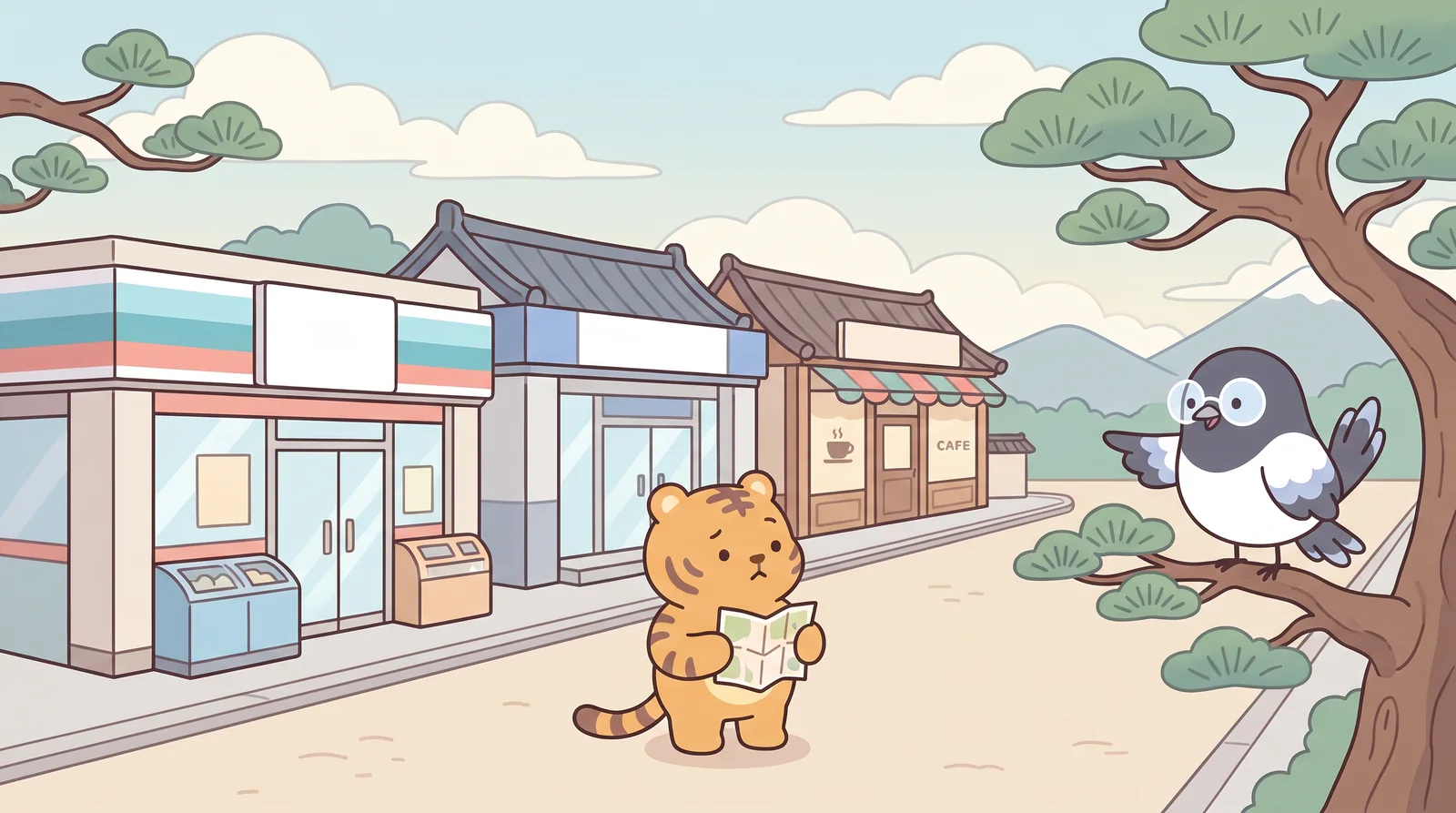
Where is the convenience store?
By the end you can
- Ask where a place is
- Describe where things are
- Name places in a town
Part 1
Where is everything?
Listen first. Then hide the English and read along. Then use Shadow: Sori or Hoya says a line, you say it back.
-

소리쌤, 편의점이 어디에 있어요?
Sori-ssaem, where is the convenience store?
-

편의점이요? 저기 은행 옆에 있어요.
The convenience store? It's over there, next to the bank.
-
은행이요? 은행이 어디예요?
The bank? Where's the bank?
-
저기 카페 앞에 있어요.
It's over there, in front of the café.
-
아, 저기요! 감사합니다.
Oh, over there! Thank you.
-
소리쌤, 편의점에 호떡이 없어요.
Sori-ssaem, there's no hotteok at the convenience store.
-
호떡은 시장에 있어요.
Hotteok is at the market.
-
시장은 어디에 있어요?
And where is the market?
-
학교 뒤에 있어요. 공원 옆이에요.
It's behind the school. Next to the park.
-
학교 뒤, 공원 옆… 여기예요?
Behind the school, next to the park… is it here?
-
아니요, 거기는 화장실이에요.
No, that's the toilet.
Part 2
Grammar
4 patterns, each with the rule and examples you can hear.
N에 있어요 / 없어요
Where something is
To say where something is, put 에 on the place: 은행 옆에 있어요 — “it's next to the bank”. The thing that is there takes 이/가.
편의점이 은행 옆에 있어요.
The convenience store is next to the bank.
소리쌤은 소나무에 있어요.
Sori-ssaem is in the pine tree.
편의점에 호떡이 없어요.
There's no hotteok at the convenience store.
앞 · 뒤 · 옆 · 위 · 아래 · 안 · 밖 · 사이
Position words
Position words come after the noun, the opposite of English: 은행 옆 is “next to the bank” (literally “bank side”). Then add 에. For “between A and B” say A하고 B 사이에.
| in front / behind | 앞 · 뒤 | 카페 앞에 · 학교 뒤에 |
|---|---|---|
| beside / on / under | 옆 · 위 · 아래 | 은행 옆에 · 책상 위에 · 의자 아래에 |
| inside / outside | 안 · 밖 | 가방 안에 · 집 밖에 |
| between | 사이 | 은행하고 카페 사이에 |
책상 위에 컴퓨터가 있어요.
There's a computer on the desk.
의자 아래에 고양이가 있어요.
There's a cat under the chair.
가방 안에 지갑이 있어요.
There's a wallet in the bag.
여기 · 거기 · 저기
Here and there
The same three distances as 이 · 그 · 저: 여기 is here (near me), 거기 is there (near you or somewhere we just mentioned), 저기 is over there.
| near me | 여기 | 여기에 있어요 |
|---|---|---|
| near you / just mentioned | 거기 | 거기는 화장실이에요 |
| far from both of us | 저기 | 저기 은행 옆에 |
여기가 학교예요.
This is the school. (Here is the school.)
저기에 은행이 있어요.
There's a bank over there.
N이/가 어디예요? · 어디에 있어요?
Asking where
어디 means “where”. 은행이 어디예요? and 은행이 어디에 있어요? both mean “where is the bank?”.
화장실이 어디예요?
Where is the toilet?
지하철역이 어디에 있어요?
Where is the subway station?
Part 3
Words
30 words. Tap a card to hear it. When you finish, they go into your review — they come back tomorrow.
asking the way
position
places
at home
Part 4
Practice
Check each answer as you go. Nothing is graded — mistakes are how this works.
Which position word?
-
(The cat is on the desk.) 고양이가 책상 ___에 있어요.
The cat is on the desk.
-
(The bag is under the chair.) 가방이 의자 ___에 있어요.
The bag is under the chair.
-
(The park is behind the school.) 공원이 학교 ___에 있어요.
The park is behind the school.
-
(The wallet is in the bag.) 지갑이 가방 ___에 있어요.
The wallet is in the bag.
여기, 거기 or 저기?
-
(You are standing at the bank.) ___가 은행이에요.
This is the bank.
-
(The station is far away.) ___에 지하철역이 있어요.
There's a subway station over there.
Put the words in order
-
The convenience store is next to the bank.
-
Where is the toilet?
-
There's a computer on the desk.
Choose the right answer
-
화장실이 어디에 있어요?
Where is the toilet?
-
시장이 학교 앞에 있어요?
Is the market in front of the school?
Part 5
Fix Hoya’s mistakes
Hoya wrote these. Each has one mistake — the kind a sensible learner makes. Say the fixed sentence before you check.
-

Say “The convenience store is next to the bank”.
Hoya wrote 편의점이 은행 옆에서 있어요.
Show the fix
편의점이 은행 옆에 있어요.
For where something is, use 에. 에서 is for where something happens — you'll meet it in Unit 4.
-
You are standing right at the bank. Say “The bank is here”.
Hoya wrote 저기 은행이 있어요.
Show the fix
여기 은행이 있어요.
You are at the bank, so it's 여기 — here. 저기 is far away from both of you.
-
Say “There's a bag on the desk”.
Hoya wrote 책상 위 가방이 있어요.
Show the fix
책상 위에 가방이 있어요.
The position word needs 에 to mean “on/at”: 책상 위에.
Part 6
Hoya's neighbourhood
Hoya draws a map of the street by the Sejong Institute and writes a note under it. Read it yourself first; tap a line to see its meaning, or listen to Hoya read it.
There's a café in front of the Sejong Institute.
There's a convenience store next to the café.
There's a park behind the convenience store.
There's a pine tree in the park.
Sori-ssaem is up in the pine tree.
There's no hotteok stall.
Check your reading
-
Where is the convenience store?
-
Where is Sori?
Part 7
Writing
Describe your room — say where five things are.
See Sori’s model answer
- 방에 침대가 있어요. There's a bed in my room.
- 침대 옆에 책상이 있어요. There's a desk next to the bed.
- 책상 위에 컴퓨터가 있어요. There's a computer on the desk.
- 창문 앞에 의자가 있어요. There's a chair in front of the window.
- 방에 텔레비전이 없어요. There's no TV in my room.

Unit 3 complete
Finish every part above, then mark the unit complete. Your words come back in Review tomorrow.