
Korean grammar · Level 1
앞 · 뒤 · 옆 · 위 · 아래 · 안 · 밖 · 사이
Position words
Taught in Level 1, Unit 3: Where is it?
"at the school" is often not enough — to actually find something you need "behind", "next to", "on top of".
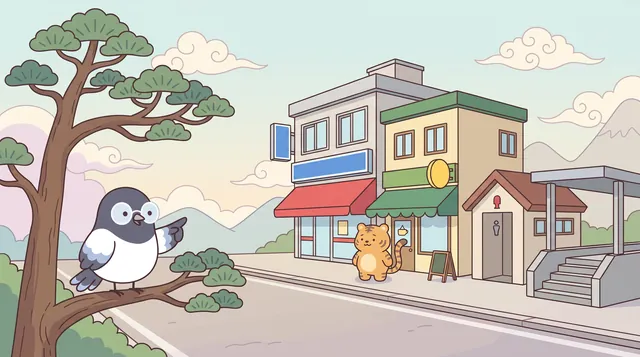
Position words are nouns, and they come after the place — the opposite order from English: 은행 옆 is "bank side", that is, "next to the bank". Then add 에 + 있어요/없어요. With 이에요/예요 there is no 에: 소나무 위예요 ("it's up in the pine tree"). For "between A and B", say A하고 B 사이에 (하고 = "and"; you will study it properly in Unit 7). For "under", speech often uses 밑 as well: 침대 밑에.
| When | Use | Example |
|---|---|---|
| in front · behind | 앞 · 뒤 | 카페 앞에 · 공원 뒤에 |
| beside | 옆 | 병원 옆에 |
| on top of · under | 위 · 아래 | 의자 위에 · 침대 아래에 |
| inside · outside | 안 · 밖 | 방 안에 · 집 밖에 |
| between | 사이 | 학교하고 병원 사이에 |
Examples
열쇠가 가방 안에 있어요.
The key is in the bag.
고양이가 방 밖에 있어요.
The cat is outside the room.
휴대폰이 침대 위에 있어요.
The phone is on the bed.
가방이 책상 아래에 있어요.
The bag is under the desk.
책상이 창문 앞에 있어요.
The desk is in front of the window.
Practise it in context · Level 1, Unit 3
Where is it?
The rule with a table, Sori’s tips, practice that checks itself, a review room and a one-page cheat sheet.
Open the unit →