
Level 1 · Beginner 1 · Unit 2
What is this?
By the end you can
- Ask what something is
- Say what you have and don't have
- Say whose something is
Part 1
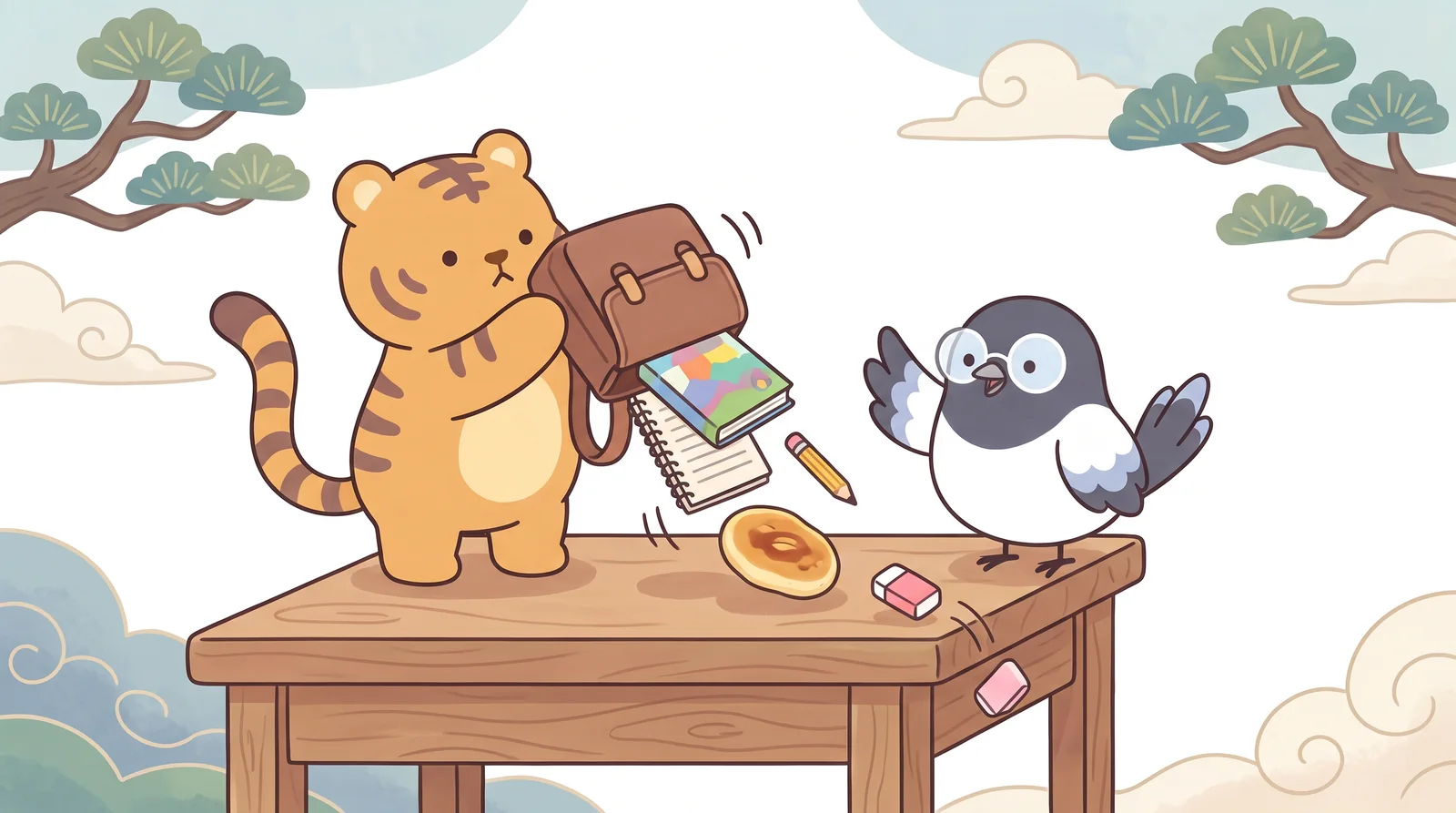
Everything in Hoya's bag
Listen first. Then hide the English and read along. Then use Shadow: Sori or Hoya says a line, you say it back.
-
호야 씨, 그게 뭐예요?
Hoya, what's that?
-
이거요? 제 가방이에요.
This? It's my bag.
-
뭐가 있어요?
What's in it?
-
책이 있어요. 공책이 있어요. 연필이 있어요.
There's a book. There's a notebook. There's a pencil.
-
지우개는요?
What about an eraser?
-
지우개는… 없어요.
An eraser… I don't have one.
-
저건 뭐예요? 저거 호야 씨 지우개예요?
What's that over there? Is that your eraser, Hoya?
-
아! 네, 제 지우개예요.
Oh! Yes, it's my eraser.
-
이건 누구 휴대폰이에요?
Whose phone is this?
-
그건 제 휴대폰이 아니에요. 소리쌤 휴대폰이에요.
That's not my phone. It's your phone, Sori-ssaem.
-
아, 제 거예요.
Oh, it's mine.
Part 2
Grammar
5 patterns, each with the rule and examples you can hear.
이거 · 그거 · 저거
This, that, that over there
Korean has three words for “this/that”, and they depend on distance. 이 is near me, 그 is near you, 저 is far from both of us. Add 거 (thing) to point at an object. In careful writing 거 is 것.
| near me | 이거 | 이거 · 이게 (subject) |
|---|---|---|
| near you | 그거 | 그거 · 그게 |
| far from both of us | 저거 | 저거 · 저게 |
이거 제 책이에요.
This is my book.
그거 뭐예요?
What's that (near you)?
저거 호야 씨 가방이에요?
Is that (over there) your bag, Hoya?
N이/가 뭐예요?
What is it?
이/가 marks the subject: 이 after a consonant, 가 after a vowel. With the pointing words it shortens: 이거 + 이 → 이게, 그거 + 이 → 그게, 저거 + 이 → 저게. 뭐예요? means “what is it?”.
| ends in a consonant | 이 | 책이 · 연필이 |
|---|---|---|
| ends in a vowel | 가 | 지우개가 · 커피가 |
이게 뭐예요?
What is this?
저게 뭐예요?
What is that over there?
그게 우산이에요.
That's an umbrella.
N이/가 있어요 / 없어요
There is, there isn't — have, don't have
있어요 means “there is” or “I have”; 없어요 means “there isn't” or “I don't have”. The thing takes 이/가. To ask “what is there?”, say 뭐가 있어요?
연필이 있어요.
There's a pencil. / I have a pencil.
우산이 없어요.
I don't have an umbrella.
뭐가 있어요?
What is there? / What do you have?
N의 · 제 · 내
Whose it is
의 means “'s” (호야 씨의 가방), but in speech it is usually dropped: 호야 씨 가방. “My” is 제 (polite, short for 저의) or 내 (casual). 제 거 means “mine”.
| polite “my” | 제 | 제 가방 · 제 거 |
|---|---|---|
| casual “my” | 내 | 내 가방 |
| someone else's | (의) | 소리쌤(의) 책 |
제 휴대폰이에요.
It's my phone.
소리쌤 책이에요.
It's Sori-ssaem's book.
이거 제 거예요.
This is mine.
누구 · 누구 N이에요?
Who and whose
누구 means “who”. Put it before a noun to ask “whose”: 누구 가방이에요? — “whose bag is it?”.
누구예요?
Who is it?
이거 누구 우산이에요?
Whose umbrella is this?
호야 씨 우산이에요.
It's Hoya's umbrella.
Part 3
Words
30 words. Tap a card to hear it. When you finish, they go into your review — they come back tomorrow.
pointing
in the bag
in the room
have
Part 4
Practice
Check each answer as you go. Nothing is graded — mistakes are how this works.
이게, 그게 or 저게?
-
(It's in your hand.) ___ 뭐예요?
What is this?
-
(It's in Sori's hand.) ___ 뭐예요?
What is that?
-
(It's on the far wall.) ___ 뭐예요?
What is that over there?
이 or 가?
-
지우개___ 있어요.
There's an eraser.
-
책___ 없어요.
There's no book.
-
우산___ 있어요?
Do you have an umbrella?
-
커피___ 있어요.
There's coffee.
제 or 저?
-
이거 ___ 가방이에요.
This is my bag.
-
___는 학생이에요.
I'm a student.
Put the words in order
-
This is my bag.
-
Whose phone is this?
-
I don't have an umbrella.
Choose the right answer
-
(Holding a book) 이게 뭐예요?
What is this?
-
누구 우산이에요?
Whose umbrella is it?
Part 5
Fix Hoya’s mistakes
Hoya wrote these. Each has one mistake — the kind a sensible learner makes. Say the fixed sentence before you check.
-
Point at a bird far up in the sky and ask what it is.
Hoya wrote 그게 뭐예요?
Show the fix
저게 뭐예요?
The bird is far from both of you, so it's 저. 그 is for something near the person you are talking to.
-
Say “There's an eraser”.
Hoya wrote 지우개이 있어요.
Show the fix
지우개가 있어요.
지우개 ends in a vowel, so the subject marker is 가.
-
Say “It's my bag”.
Hoya wrote 저 가방이에요.
Show the fix
제 가방이에요.
저 means “I”. “My” is 제 — it comes from 저의.
Part 6
What's in Hoya's bag
Hoya makes a list before class. One line surprises Sori. Read it yourself first; tap a line to see its meaning, or listen to Hoya read it.
This is my bag.
There's a book.
There's a notebook. There's a pencil.
There's no pen.
There's an eraser… sometimes.
There's hotteok! There are two.
Check your reading
-
Is there a pen in Hoya's bag?
-
What food is in the bag?
Part 7
Writing
Write five things you have in your bag — and one you don't.
See Sori’s model answer
- 제 가방이에요. This is my bag.
- 책이 있어요. 휴대폰이 있어요. There's a book. There's a phone.
- 지갑이 있어요. 열쇠가 있어요. There's a wallet. There's a key.
- 우산이 없어요. I don't have an umbrella.
Unit 2 complete
Finish every part above, then mark the unit complete. Your words come back in Review tomorrow.